TL;DR
- Professional window cleaning uses specialist tools, technique, and glass knowledge that general cleaners do not have.
- Most Vienna cleaning companies offer window cleaning as a side service, not a core specialty.
- A true professional window cleaning service matches technique to glass type, frame material, and contamination level.
- Streak-free results depend on water chemistry, squeegee rubber, and method, not effort or product alone.
- Orloff's Window Cleaning Service is a single-specialist operation: every job performed by one certified craftsman.
Someone asked me recently if I was "just a window cleaner." I did not get defensive. I asked them one question: "Have you ever had your windows professionally cleaned before?" They had not. That is almost always the answer. And it explains everything about why the question gets asked in the first place.
There is a gap between what most people think professional window cleaning is, and what it actually is. That gap costs homeowners money, costs them time, and costs them results they never quite get. Closing that gap is what this article is for.
Why Most Window Cleaning in Vienna Is Not Professional Window Cleaning
In Vienna, if you search for someone to clean your windows, you will find dozens of general cleaning companies. They clean offices, stairwells, carpets, kitchens, and, yes, windows. Window cleaning is one item on a list of twenty services. That is not a specialty. That is a side task handled by whoever is available that day, using whatever equipment the company stocks for general-purpose work.
A professional window cleaning service is different at the foundation. Window cleaning is the only thing on the list. Every piece of equipment, every technique, every decision about chemistry and method exists because of glass and nothing else. That focus changes everything about the outcome.
When I started in Melbourne in 1999, I learned from people who had been doing this for decades. The first lesson was not how to use a squeegee. It was how to read a window. What kind of glass? What coating, if any? What contaminants are present? Mineral deposits from hard water behave differently than construction dust, which behaves differently than salt spray, which behaves differently again from oxidised sealant residue. The treatment follows the diagnosis. A general cleaner does not make that diagnosis. They apply the same method to every surface and move on.
What Does Professional Window Cleaning Actually Involve?
Professional window cleaning is systematic. It starts before the first drop of water touches the glass.
I assess the frame material first. Aluminium, painted timber, uPVC, and historic Viennese Kastenfenster all respond differently to the same chemical. A cleaning agent that is safe for powder-coated aluminium can damage unsealed timber or lift aged paint from a period frame. Getting this wrong is not a minor error. It can mean replacing a frame, not just cleaning it.
Then the glass itself. Coated glass, tempered glass, laminated glass, and standard float glass each have specific rules. Coated glass, for example, cannot be scraped with a razor blade without risking permanent damage to the surface. Most people do not know their windows are coated. A professional checks before touching. I have written about this in more depth in why your window cleaner should understand glass coatings, because it is that important.
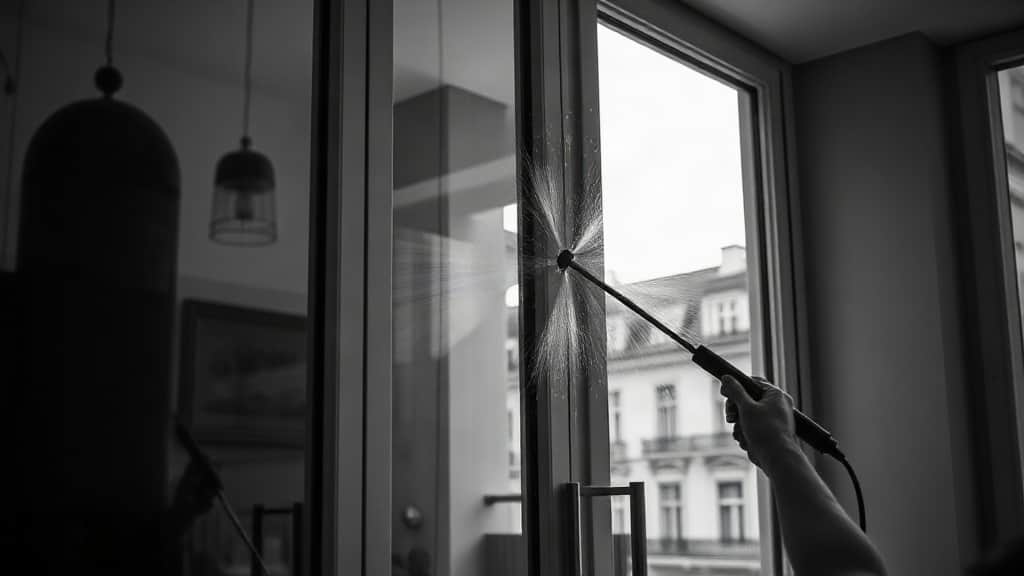
Water quality matters more than almost any other variable. Tap water in Vienna is excellent for drinking. It is less ideal for streak-free glass because of its mineral content. Hard water leaves deposits as it dries. That is why I use a pure-water system for exterior work: water filtered to near-zero parts per million, so when it dries, nothing is left behind. No minerals, no residue, no streaks. The physics of it are simple: if there is nothing dissolved in the water, there is nothing to leave on the glass. My pure-water reach extends to 24 metres, which covers four to five storeys without scaffolding or a cherry picker.
The squeegee technique is its own discipline. The rubber blade needs to be in perfect contact with the glass across its full width. The angle, speed, and pressure determine whether you get a clean pull or drag a water trail into the dry area. I use what I call a "turn with a twist" at the end of each stroke to close out the water path cleanly. It takes time to develop and it is not something you pick up from a YouTube tutorial in an afternoon. It is muscle memory, built over thousands of windows.
Why DIY and General Cleaners Keep Producing the Same Disappointing Results
The frustration is real. You spend a Saturday afternoon with a spray bottle, a roll of kitchen paper, and reasonable effort. The windows look fine when you finish. Then the afternoon sun moves and every smear and streak appears in sharp relief. You try again. Same result. You hire a general cleaning company. They send two people with a mop-style applicator and a bucket of general-purpose cleaner. Marginally better. Still not right.
This is not a failure of effort. It is a mismatch of method and material. Kitchen paper leaves lint. Microfibre cloths, used incorrectly, spread rather than lift contamination. General-purpose glass cleaners contain alcohol that evaporates fast and leaves a film. Tap water leaves mineral traces. None of these problems have anything to do with how hard the person is trying.
I get asked about home remedies regularly. Vinegar is the most common one. I covered this in detail in my honest assessment of cleaning vinegar on windows. Short version: it can work on mild mineral deposits on plain glass, but it is not a substitute for professional technique and it carries real risks on certain surfaces. The appeal of the home remedy is understandable. The results rarely match the appeal.
What Separates a Specialist From a Generalist in Practice
Here is the clearest way I can put it. A generalist cleans windows. A specialist reads the window, chooses the right method for that specific surface and contamination type, executes with technique built over years, and leaves nothing behind except clarity.
The specialist also knows when not to clean. "Don't clean a broken window" was the first lesson I received in 1999. It sounds obvious, but the principle runs deeper than the words. If there is a problem with the frame, a failing seal, or damage to the glass, cleaning is not the right first step. Calling it out is. A professional window cleaning service includes that assessment. A general cleaner does not.
Access is another dimension. Difficult windows, high windows, rooflights, glass facades, and structural glazing all require a different approach to reach them safely and clean them correctly. I hold a Level 3 industrial rope access certification. That credential does not come from a weekend course. It covers working at height in conditions where the margin for error is zero. Most general cleaning companies do not send rope access technicians to clean second-floor windows. They use extension poles with general-purpose heads and hope for the best. The result is visible in the quality.
Is Professional Window Cleaning Worth It for a Private Home?
Yes, and the reason goes beyond clean glass. A well-maintained window protects the investment in the property itself.
Mineral deposits left on glass do not just look bad. Over time, they etch into the surface. Hard water stains that are allowed to build up for one or two years can reach a point where standard cleaning will not remove them and the glass needs treatment with a mild acidic compound or, in severe cases, polishing or replacement. I covered the chemistry and mechanics of this in my guide to hard water stains on glass. Prevention is always less expensive than correction.
Frames accumulate biological growth in Vienna's climate: algae, mould, and lichen around the seals and in the corners of the frame reveal. Left untreated, they work into sealants and degrade them. A professional clean includes those areas, not just the glass pane.
The practical reality for homeowners in Hietzing, Döbling, and Währing, where many of my clients live, is that the properties are substantial. Period facades, large glazed areas, Kastenfenster that have been in place for a century. These are not surfaces for experimentation. They require someone who knows exactly what they are dealing with.
What My Clients Actually Experience
Chris from Hietzing told me: "We had used numerous cleaning services before, but Orloff's attention to detail was on a different level. Not a single streak in sight." That is not a marketing line. It is the direct comparison between what a general cleaning service delivers and what a specialist delivers, described by someone who has experienced both.
Emma from the 19th district said I "restored a clarity she had never seen before." That is worth sitting with for a moment. She had been in that home for years. The windows had been cleaned before. But the clarity she described was new. That is the gap between cleaning and professional window cleaning.
My repeat-client rate sits at 95 percent. That number is not driven by marketing. It is driven by results that hold up every time, and by the experience of having someone in your home who treats it the way I treat my own. I run one job at a time, personally. There is no crew. There is no subcontractor. What you see when you contact me is what arrives at your door.
The Scarcity Is Real
I deliberately limit the number of clients I take each season. This is not a sales tactic. It is the arithmetic of a one-person operation that refuses to compromise on results. Repeat clients book ahead. New clients sometimes wait. When my calendar is full, I say so and I turn work away. The alternative is rushing jobs, and rushing is where quality ends.
If you are reading this having never had a truly professional clean done on your windows, I would encourage you to experience it once and judge for yourself. The difference is visible from inside the room, in any light, at any angle.
Ready to See the Difference?
If you want windows cleaned by someone who has done nothing else for 25 years, across two continents, on properties ranging from heritage residential buildings to modern glazed facades, I would be glad to hear from you. Tell me a little about your property and I will come back to you within one working day with honest information about what your windows need.
Schreiben Sie mir, and let's talk about your windows.
Frequently Asked Questions
What is the difference between a window cleaner and a professional window cleaning service?
A window cleaner may refer to anyone who cleans windows, including general cleaning companies that offer it as one of many services. A professional window cleaning service specialises exclusively in glass, with dedicated equipment, technique, and knowledge of glass types and coatings. The outcome in quality and durability of the clean is consistently different.
How do I know if my windows need professional window cleaning or can I do it myself?
If your windows have mineral deposits, biological growth around the frames, or coated glass, professional window cleaning is the safer and more effective choice. DIY attempts on coated or heritage glass can cause permanent surface damage that costs significantly more to correct than the original clean would have.
How often should windows in Vienna be professionally cleaned?
For most residential properties in Vienna, twice a year is a practical baseline. Properties near construction zones, busy roads, or with south-facing glazing that attracts bird activity may benefit from three or four cleans per year. I cover this in detail in the article on how often you should clean windows in Vienna.
Does professional window cleaning use different products than what I can buy?
Yes. Professional window cleaning relies on controlled water chemistry, purpose-built applicators, and squeegee rubbers that are replaced regularly to maintain consistent blade contact. Consumer spray products typically contain alcohol or fragrance additives that leave a residue on glass rather than removing contamination cleanly.
Can a professional window cleaning service reach high or difficult windows?
A specialist service with the right equipment and certifications can reach windows that general cleaners cannot. I use a pure-water fed pole system to 24 metres and hold a Level 3 industrial rope access certification for work above that height or in technically complex access situations.
Is professional window cleaning worth the cost for a private residence?
For most homeowners who have experienced it once, the answer is yes. Beyond the immediate visual result, professional window cleaning protects the glass from mineral etching, the frames from biological degradation, and the seals from premature failure. The cost of prevention is reliably lower than the cost of repair or replacement.